

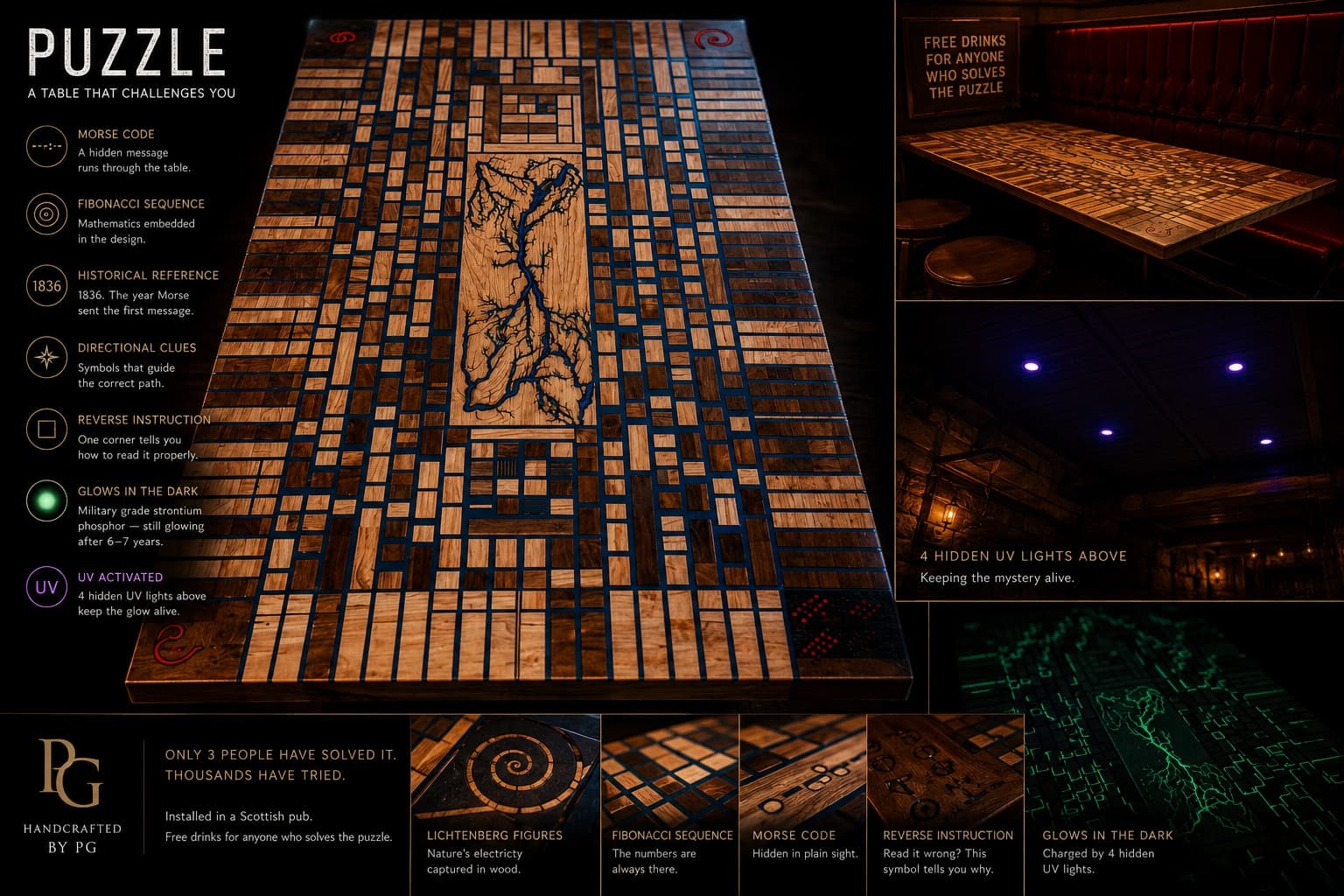
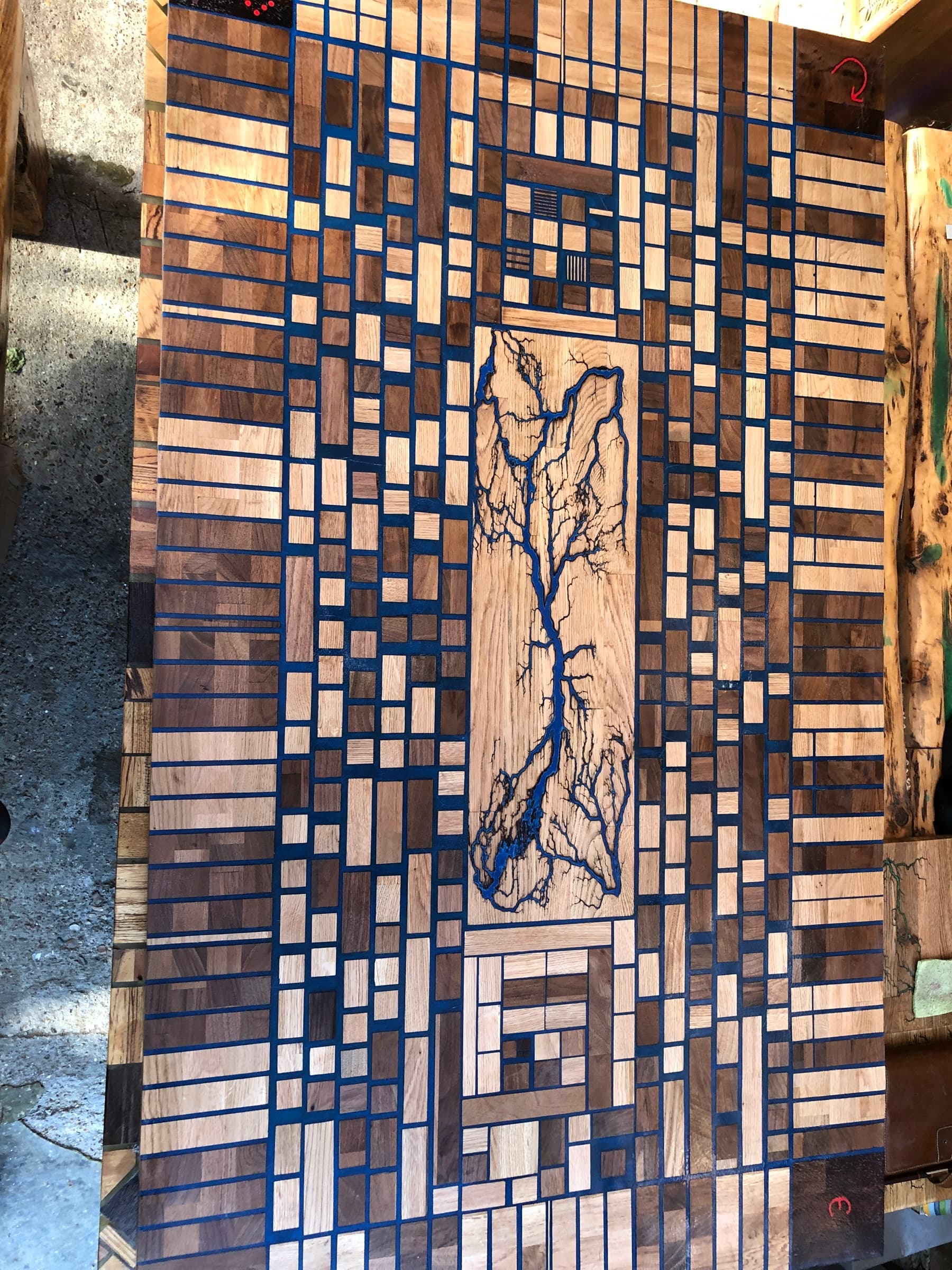
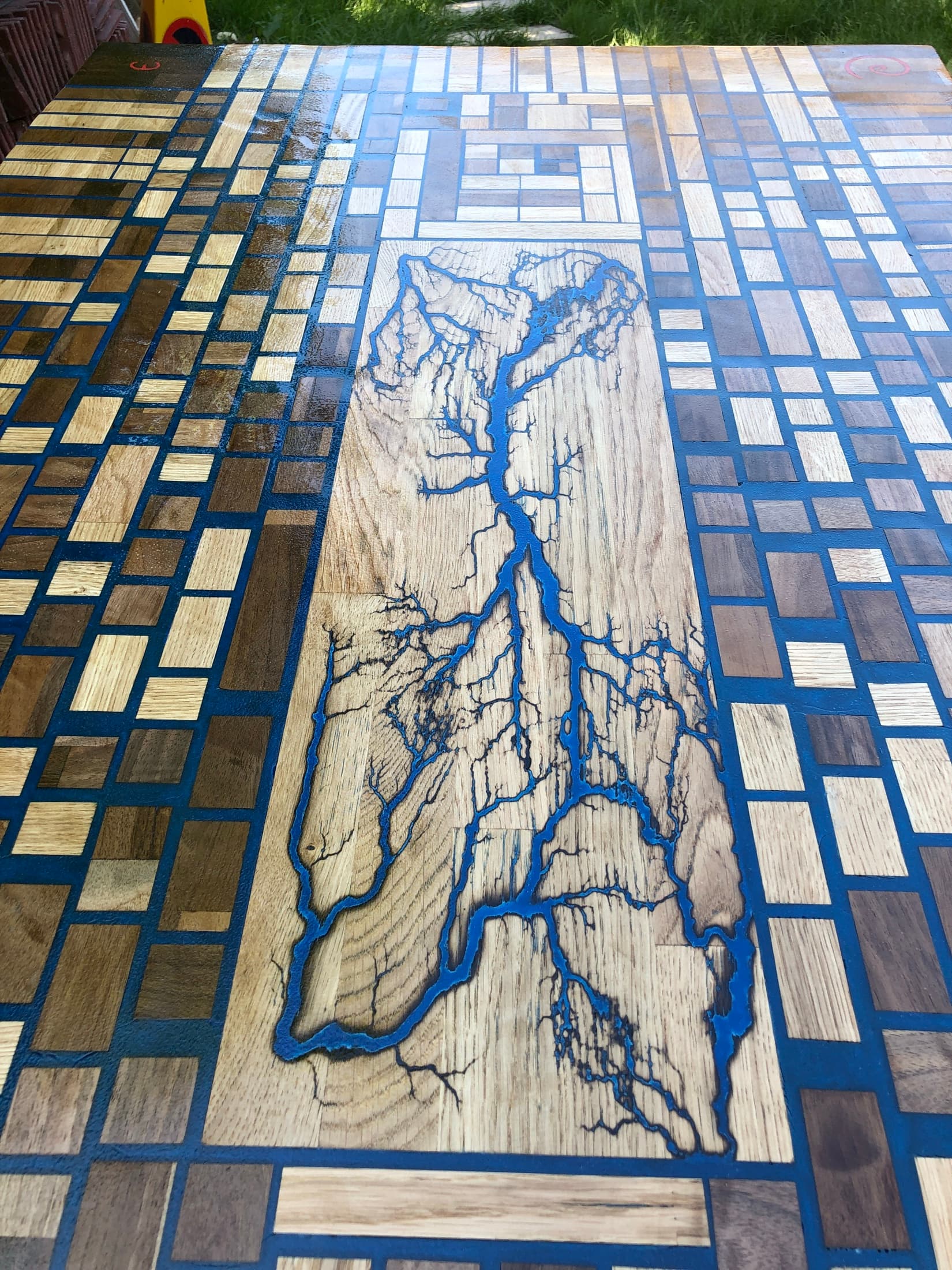
An end-grain parquetry top built from hundreds of individual oak and walnut blocks, centred on a Lichtenberg burn fractal filled with blue-pigmented resin — and, underneath the pattern, four separate puzzles encoded directly into the construction.
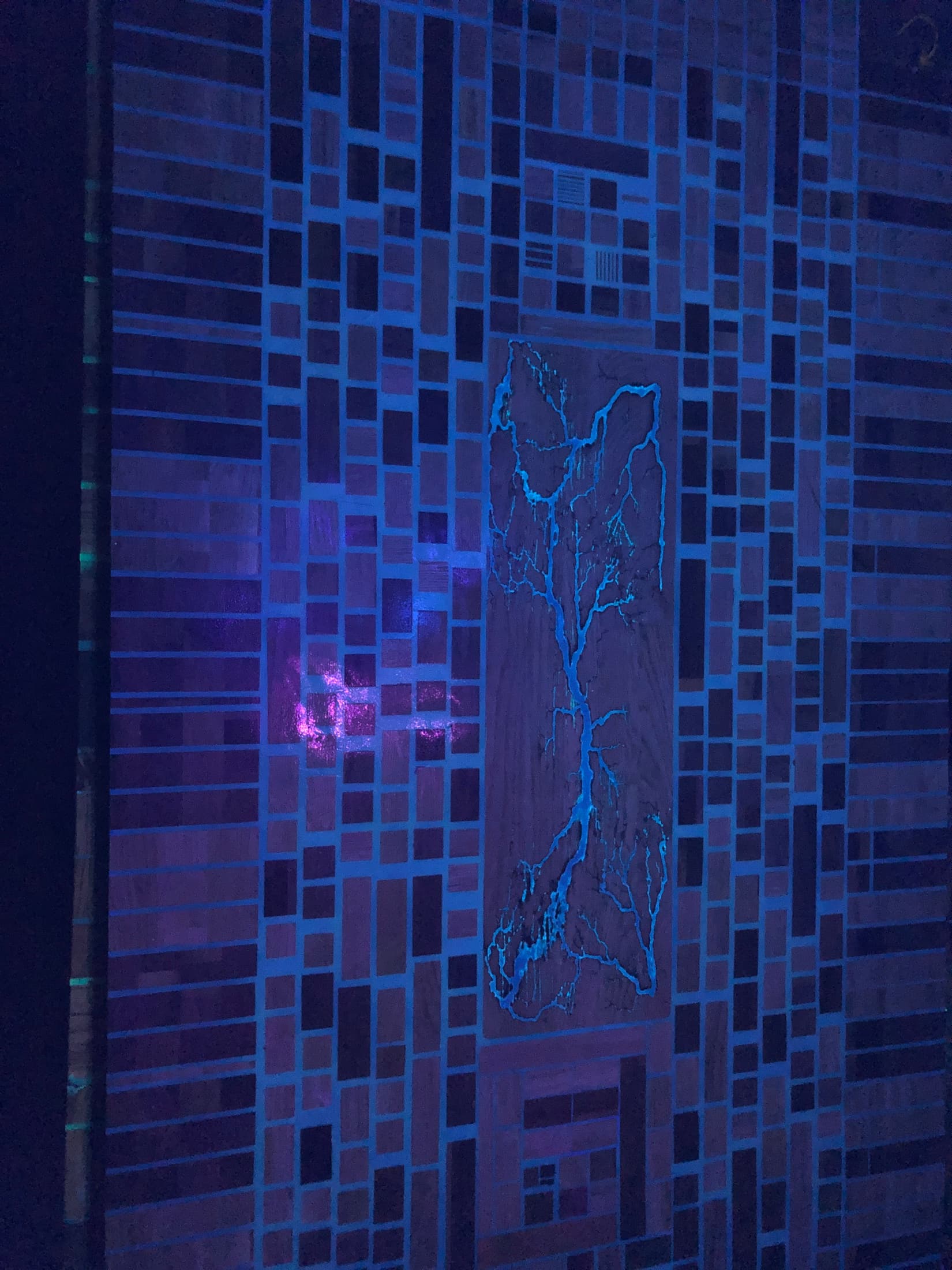
Inert by daylight, fully alive under blacklight — the same surface reads as two completely different objects depending on how it's lit.
The piece, in full
Available on request
Made to order
Enquire for availability
Inside the puzzle
Four puzzles are built into the table, confirmed directly by the maker, Peter Gvozdev:
1 — The key: the Fibonacci sequence (1, 1, 2, 3, 5, 8, 13, 21, 34, 55…) sets the direction in which the block pattern has to be read. Without it, the other three puzzles can't be decoded.
2 — Read that way, the outer border of blocks spells SOS in Morse code.
3 — Read the same way, the inner blocks spell a second message: "Keep calm and build tables, designed by Peter Gvozdev."
4 — A single raised block of wood, distinct in height from the rest of the parquetry, marks 1836 — the year Morse code was invented.
This isn't a marketing claim: it's confirmed by dated archive material. Screenshots from the design phase show the maker researching the Fibonacci sequence and the origin of Morse code side by side with the build photos. A Facebook thread in the "Wood Club UK" group shows a member, Moray Johnstone, correctly guessing the Morse-code table on 7 May 2018 — and a photo from the same day shows a real £100 prize cheque written out to him for the correct guess.
As described by the maker
As the maker tells it: the table is installed in a Scottish pub, with free drinks on offer to anyone who solves it. Only three people are known to have managed it so far, against thousands of attempts. The glow itself is a military-grade strontium phosphor, rated to keep glowing for six to seven years after each charge — and one corner of the table carries a fifth mark, a reverse instruction, for reading the pattern correctly.
Every ElectroWood piece is one-off — a new commission won’t be identical to Puzzle Table, but can draw on the same techniques, palette or scale, made to any custom size.